
Make the right decisions at the right time and get more return from product, innovation and transformation
For CEOs & Product, Technology, Digital and Transformation Leaders who connect executive strategy with product, innovation and transformation priorities and investments
The Hidden Cost of Decision Friction
Your people are capable. Your strategy may be sound.Yet important initiatives still stall, choices get revisited, and moving the work forward takes far more energy than it should.As product, innovation and transformation work spans more teams and functions, the information and understanding needed to make good decisions become spread across the organization.Customer insight, product and technology knowledge, operational experience, market signals and learning from earlier initiatives sit in different places, and different leaders naturally see the situation from their own areas of responsibility.The overall view can then remain incomplete, especially when the organization is trying to recognize new opportunities, innovate and develop new solutions.Valuable information and observations may already exist, but they do not always become visible or receive the right weight when leadership comes together to decide what to do.The challenge is therefore not only bringing that intelligence together.Leadership also needs enough shared understanding of the situation, what matters for the shared objective and what needs to be decided.That does not require everyone to agree on everything.But when that alignment is there, decisions are easier to make and carry into coordinated action.
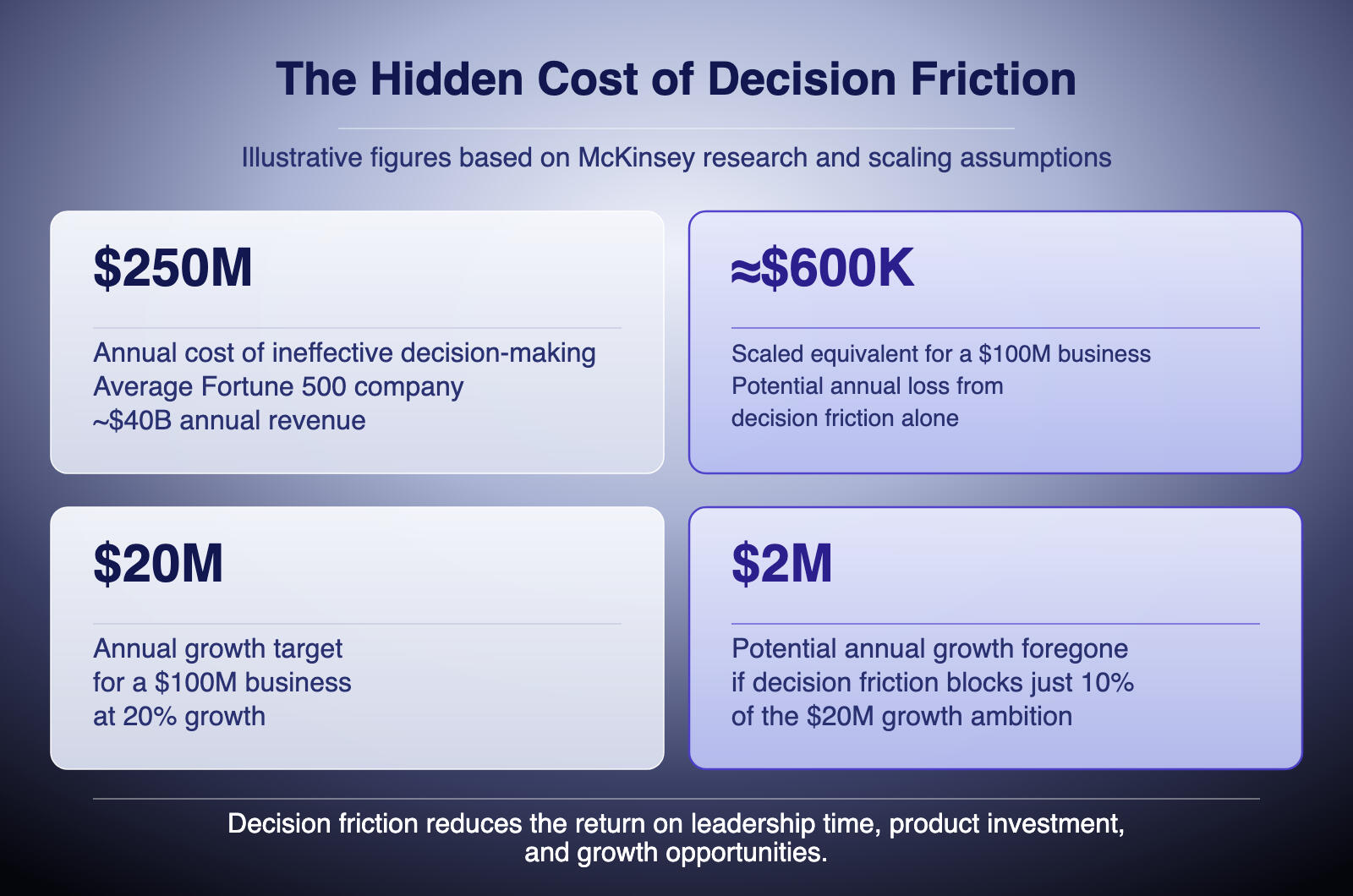
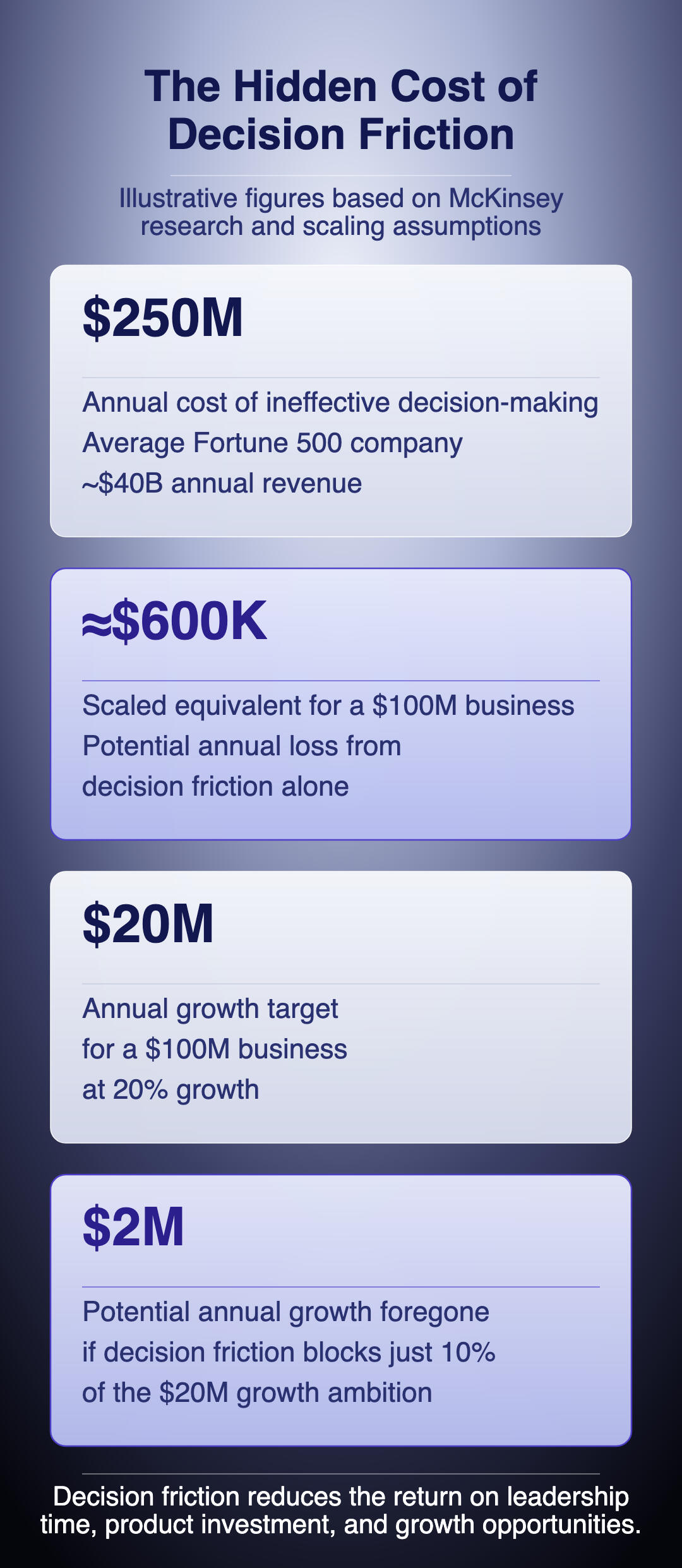
Decision friction has two economic costs.The first is the visible cost of decision-making itself: leadership time spent revisiting choices, coordinating across functions, resolving competing priorities and getting important work moving again.The second is potentially much greater.The return lost when product, innovation and transformation investments are directed at the wrong problems, promising opportunities move too slowly, learning from earlier work is not carried forward, or execution fails to create the customer and business value the investment was intended to produce.The real opportunity is therefore not simply to make decisions faster.It is to make the right decisions at the right time and turn them into coordinated action, increasing the return on the time, money, attention, expertise and energy invested in growth.
What becomes possible when organizations think better together?
As organizations grow and transform, important decisions increasingly cross functions, teams and areas of responsibility.Making those decisions well depends on more than having good information.It depends on how effectively people can bring what they know together, make sense of it and decide what matters.That is where collective organizational intelligence begins to develop.Customer and market insight, operational knowledge, previous learning and people’s observations and experience can be examined together rather than remaining scattered across the business.Human thinking and AI work together in this process, both contributing patterns, connections and new possibilities.AI adds speed and scale to analysis and synthesis, while people’s experience, intuition, imagination and judgment guide the exploration throughout.Considering these findings from different perspectives helps leaders develop enough alignment to prepare decisions and move forward together, without requiring complete consensus.The Leadership Growth System develops this way of working over time, connecting information, decisions, execution and learning while strengthening people’s own thinking and problem-solving abilities.Each cycle adds to what the organization knows and can do, building an evolving capability to recognize opportunities, innovate and turn decisions into customer and business value.
Who this is for
The Leadership Growth System is for CEOs & Product, Technology, Digital and Transformation Leaders who connect executive strategy with the product, service, technology, transformation and investment priorities that shape growth.They often sit on a business unit or executive leadership team while also leading their own product, technology, digital or transformation organization.Their role sits between strategy and execution.They make the choices about where the business is going while creating the conditions for teams to act on those choices and make decisions within their own areas of responsibility.Leaders in these roles include CEOs of rapidly growing or transforming organizations, Chief Product Officers, Chief Digital Officers, Chief Technology Officers, Senior Vice Presidents, Vice Presidents, General Managers, Business Unit Leaders, Transformation Directors, and other senior leaders responsible for growth, innovation and cross-functional execution.
Leadership Growth System usually starts with a Decision Accelerator
We begin with an initial, no-obligation conversation about your current situation and where this way of working could create the most value.If we see a good fit for working together, the first step is usually a Decision Accelerator, a focused first application of Leadership Growth System around one important decision, initiative, objective or organizational learning question.Together, we agree on the scope, intended benefit, participants and timetable.The engagement typically takes one to two months, with the timing adapted to your organization’s needs and adjusted as the work progresses.This first phase is designed to create value in its own right while laying the foundation for continuously evolving organizational intelligence and capability.We design and guide the work, bringing it into existing leadership meetings and practices wherever possible.1. REALITYWe bring together relevant information, observations and learning from across the organization.People’s experience, analytical thinking, intuition and imagination work alongside AI-supported analysis and synthesis to identify patterns, question assumptions and explore new possibilities.2. ALIGNLeaders examine what the findings mean for the objective and different parts of the organization, building enough alignment to clarify the decisions needed, their sequence and what still needs to be resolved.3. DECIDE & COMMITLeaders weigh the options, make the decisions that are ready, and agree on responsibilities, resources and next steps.4. EXECUTE & LEARNTeams put the agreed actions into practice and review progress against the intended benefit, bringing results, experience and new observations into subsequent decisions.Throughout the Decision Accelerator, your organization makes the decisions and retains responsibility for implementation.The practices and tools become embedded in your organization through the work, so they can continue to be used and developed.As this approach extends across further decisions, teams and initiatives, each cycle builds on what came before, strengthening both the knowledge available and people’s ability to think and act together.This helps the organization recognize new growth opportunities and develop better products, services and ways of working together.
You may recognize some of these in your organization:
You may already have a view of where the organization needs to go, but helping others understand the direction, commit to the decisions and move forward together takes too much of your time and energy.
An important investment or decision is approaching, but leadership views do not yet align sufficiently, essential information is missing, or it is unclear which decisions need to come first.
Important decisions can depend too much on who happens to be in the room, whose voice carries the most weight, or which perspectives happen to be represented.
Customer insight, market signals, product knowledge and operational experience don’t always come together when important decisions are made, leaving valuable observations and new opportunities overlooked.
Teams work hard, but important initiatives still lose momentum, stall or struggle to create the expected customer and business value.
Different parts of the organization pursue overlapping or duplicated initiatives, missing opprtunities to use other’s knowledge or develop solutions together.
Ownership or decision authority becomes unclear once work crosses team or functional boundaries.
Leaders spend too much of their time coordinating, resolving competing priorities or filling gaps between teams, while decisions get revisited and progress depends on their continued involvement.
An acquisition, merger or major organizational change creates a need to establish a shared direction and agree how different teams will put it into practice.
Valuable learning from initiatives and transformations doesn’t consistently carry into the next initiative or across the organization, so teams repeat work or encounter problems others have already learned from.
You may not be entirely confident that your product, innovation or transformation investments are creating as much value or return as they could.
You sense the organization could recognize new growth opportunities and develop better products, services and ways of working, but turning that potential into progress is difficult.
Any one of these situations can provide a starting point for the Decision Accelerator.Where these challenges recur across teams and initiatives, that first application can develop into a wider Leadership Growth System, strengthening how the organization thinks, decides, executes and learns.
From the Decision Accelerator to the wider Leadership Growth System
The Decision Accelerator establishes the foundations through work on one important situation.The wider Leadership Growth System develops those foundations across multiple decisions, objectives and initiatives, connecting shared leadership thinking with the information, tools and practices that support it.Information and observations inform decisions, while results and experience feed back into a growing organizational knowledge base and the workflows people use.Each cycle strengthens the foundation for the next, developing both the intelligence available and people’s ability to create, decide, execute and learn together.As this capability takes hold, the changes we work toward include:
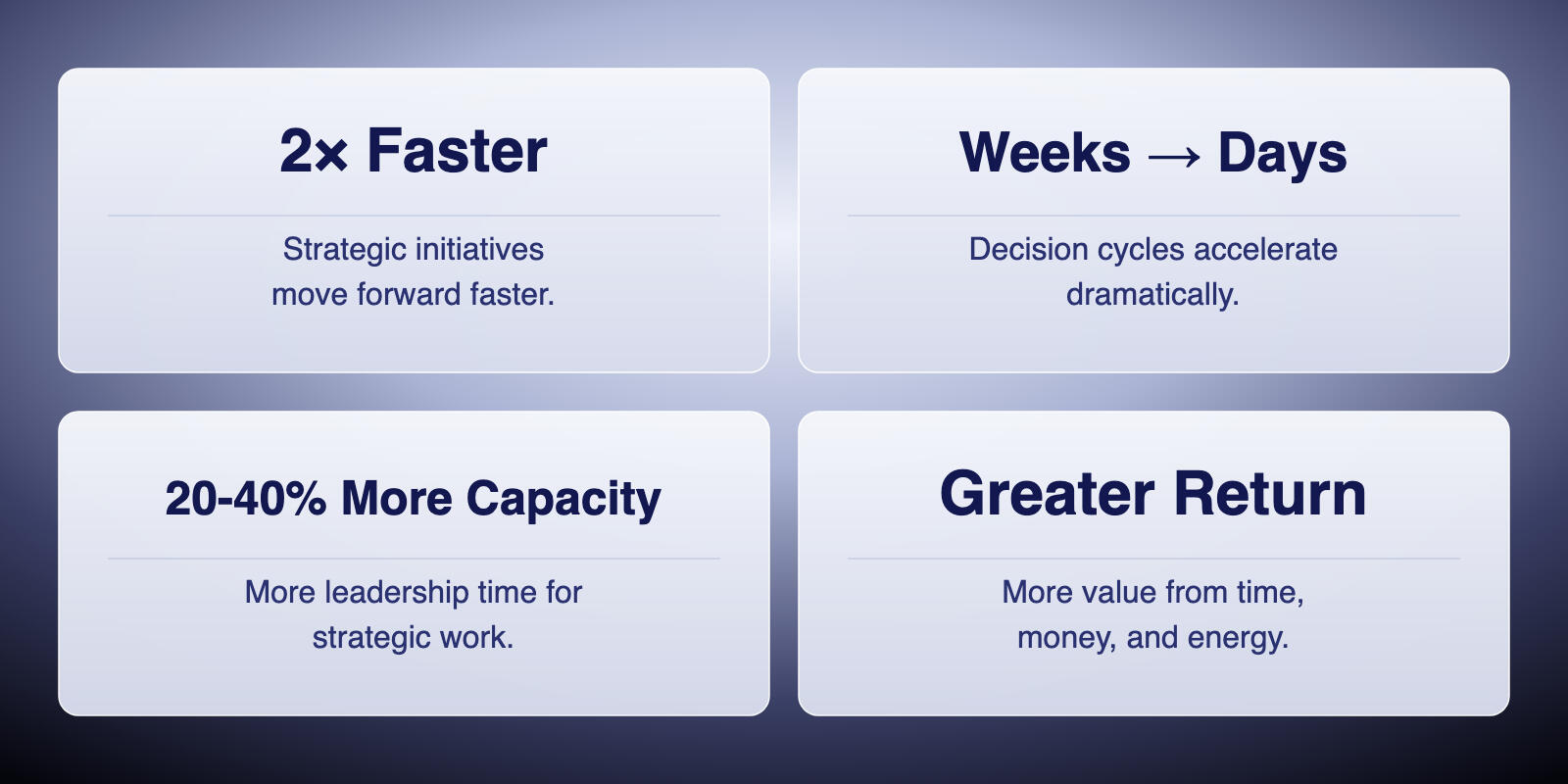
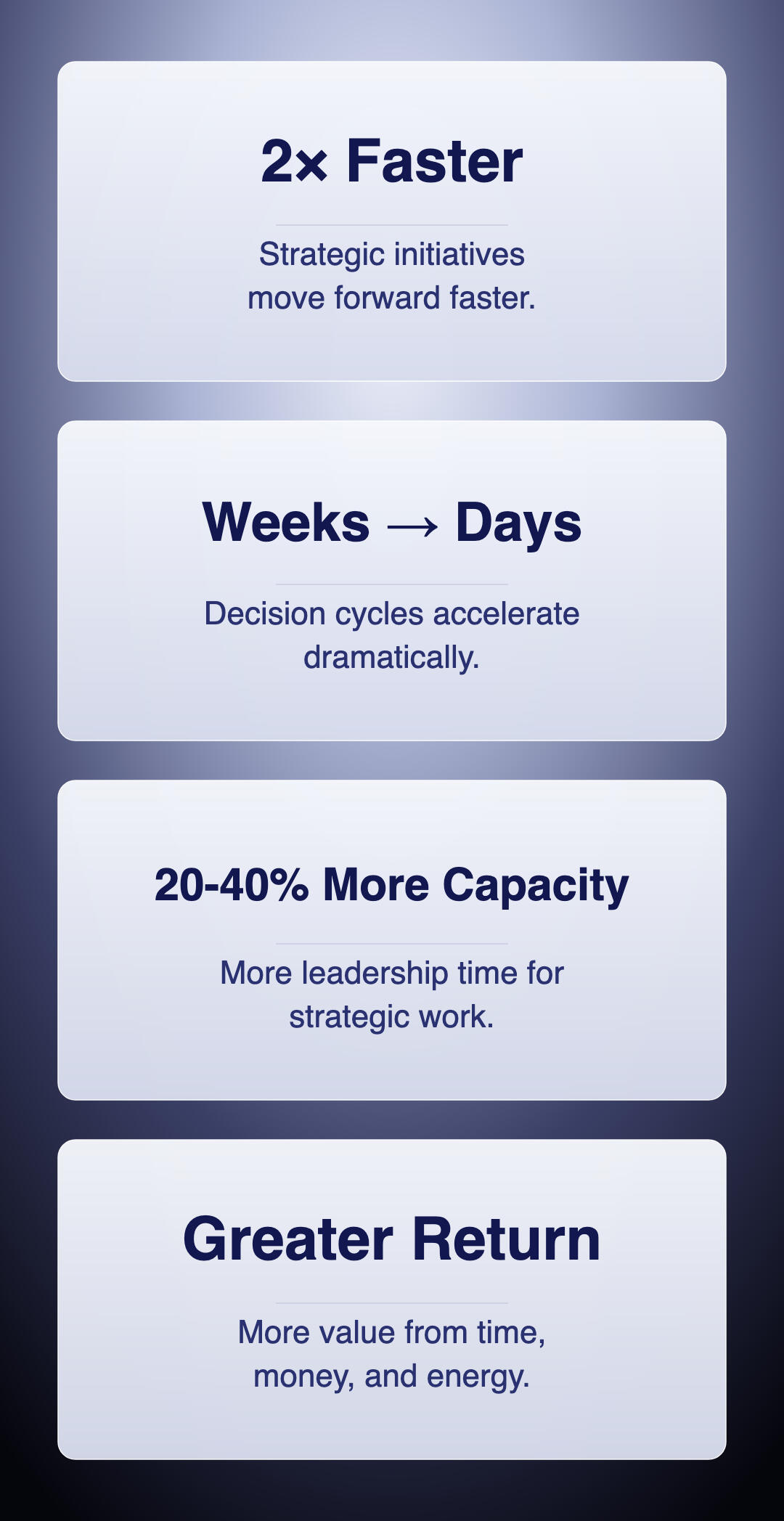
Strategically important initiatives moving forward at least 2× faster, through stronger alignment, clearer priorities and better-prepared decisions.
Decision cycles reduced from weeks to days, and sometimes hours, as relevant information, decision authority and dependencies become clearer before leaders reach the point of decision.
20-40% more leadership capacity for strategic thinking, innovation and long-term growth, through clearer ownership, greater team autonomy and less need for constant coordination.
Higher-quality leadership decisions made with greater confidence and commitment, informed by relevant evidence, different perspectives and clear reasoning.
New growth opportunities and better products, services and ways of working, by connecting customer and market insight with knowledge across the organization.
Learning that carries across teams and into future initiatives, reducing repeated work and helping people build on what others have learned.
Continuously strentghening capacity to think creatively, recognize possibilities and exercise sound judgment, combining human experience, intuition and analytical thinking with the additional patterns and connections AI can help reveal.
Greater return on the time, money and energy invested in innovation and transformation, through better investment choices and more coordinated execution.
The numerical improvements are targets to assess against your organization’s starting point, with results depending on the scope, participation and changes put into practice.Together, these developments create continuously evolving organizational intelligence and decision-making capability, embedded in how the organization works and grows.
The Five Stages of Leadership Growth
These five stages describe how the wider organizational capability develops through the Leadership Growth System over time.
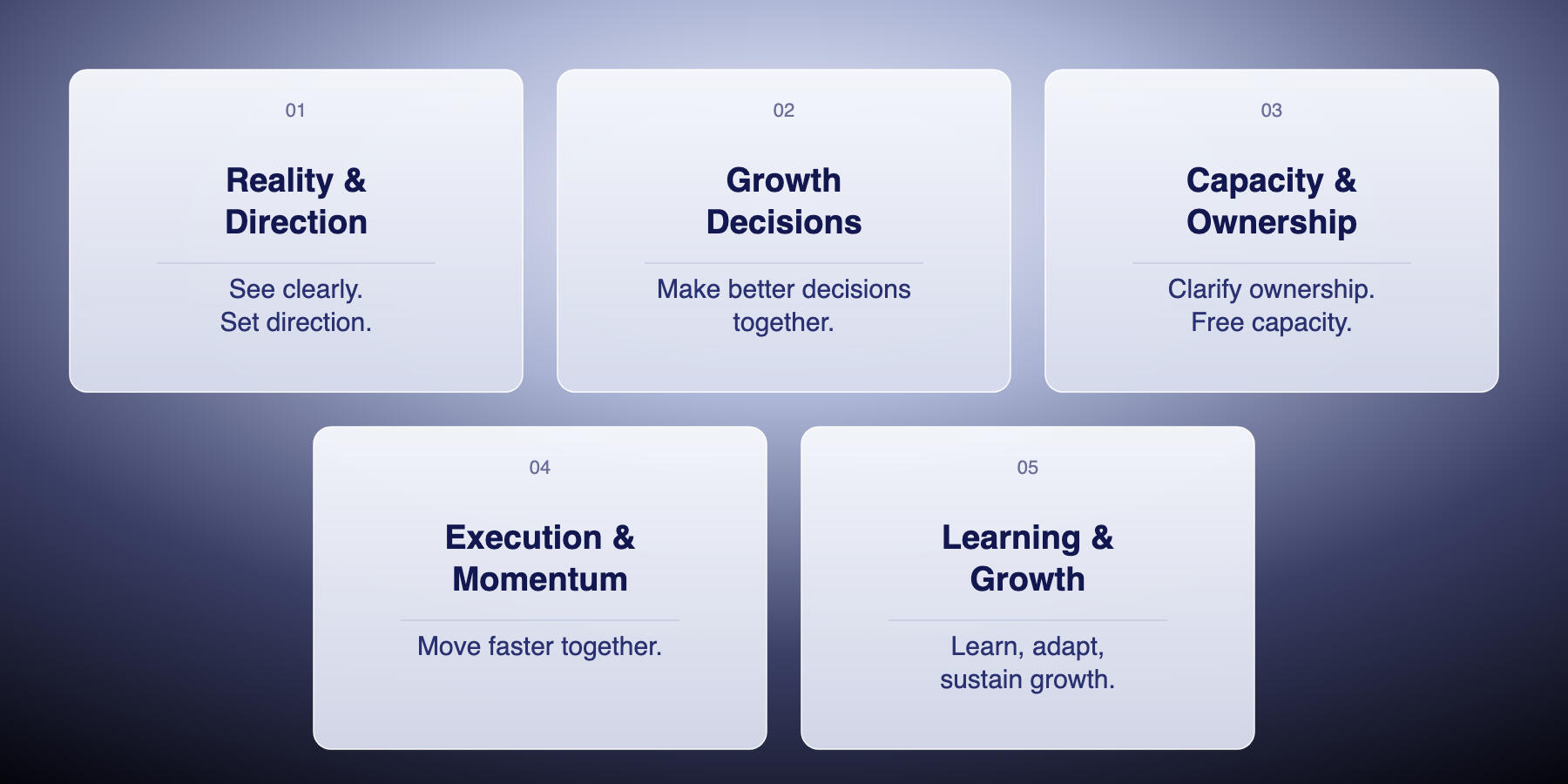
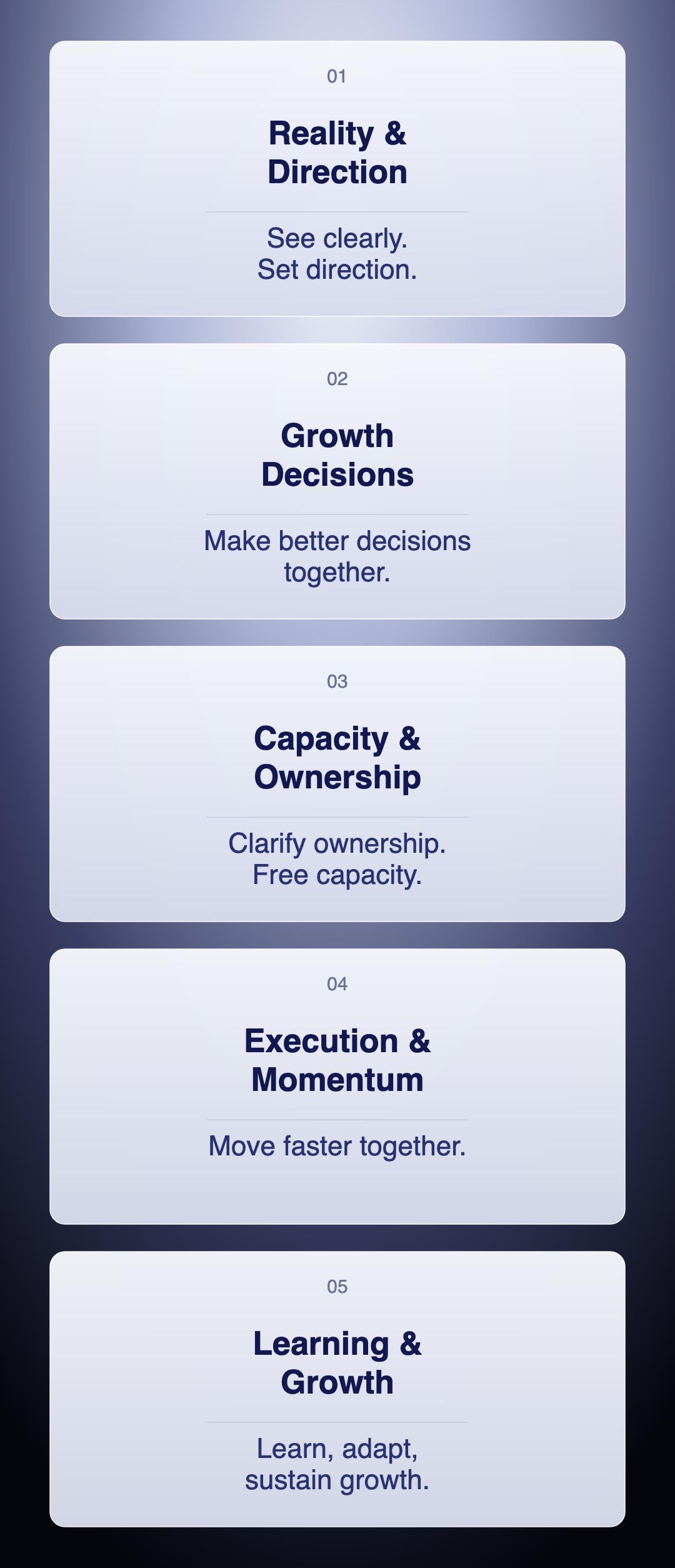
1. Reality & Direction
Recognize the patterns shaping your organization’s current reality and establish a shared direction for growth
Reveal the patterns creating decision friction and slowing growth.
Surface the customer, operational, and leadership signals that matter most.
Clarify growth priorities, objectives, and desired outcomes.
Identify gaps in strategic clarity and organizational coherence.
Align leadership thinking and operating patterns with the direction you want to create.
What you'll notice:"We see our organization, our growth opportunities, and ourselves as leaders much more clearly."
2. Growth DecisionsTransform how leaders and teams prepare for, make, and commit to strategically important decisions.
Replace limiting decision patterns with ones that accelerate growth.
Bring fragmented customer, team, and leadership insight together.
Ensure the right intelligence, perspectives, and judgment inform decisions.
Use AI-supported synthesis while keeping decisions fully human-led.
Build stronger commitment around priorities and coordinated execution.
What you'll notice:“We make better decisions together, commit with greater confidence, and stop getting stuck in endless discussions.”
3. Capacity & OwnershipCreate the clarity, ownership, and leadership capacity needed for faster, more autonomous execution.
Free leadership capacity for strategic work.
Clarify ownership, accountability, and decision authority.
Strengthen delegated decision-making and reduce unnecessary escalation.
Identify capability gaps that limit growth.
Build greater autonomy and distributed leadership across the organization.
What you'll notice:"People know what they own, what they can decide, and where they can move forward without waiting for permission."
4. Execution & MomentumStrengthen the coordination patterns that help teams move together with greater speed and confidence.
Move strategically important initiatives forward faster.
Improve cross-functional coordination and execution.
Increase team autonomy and distributed decision-making.
Enable teams to solve problems without constant escalation.
Accelerate learning and course correction during execution.
What you'll notice:"The organization moves together with greater speed, clarity, and confidence."
5. Learning & Continuous GrowthEmbed the ways of thinking, deciding, coordinating, and learning that sustain long-term growth.
Strengthen the decision patterns that support innovation and growth.
Carry learning from one initiative into the next.
Strengthen how the organization notices signals, interprets what they mean and challenges established assumptions.
Turn learning from decisions and execution into stronger intelligence for what happens next.
Improve the organization’s ability to sense, decide, execute and adjust.
Sustain growth while increasing organizational resilience.
What you'll notice:"The organization increasingly learns, adapts, and grows as an integrated system rather than a collection of separate teams."Additional features:
Human-led, AI-supported decision support.
Designed to fit within existing workflows.
No major technology investment required.
Early momentum and measurable progress within as little as two weeks.
What makes the Leadership Growth System different?
The Leadership Growth System works with the recurring organizational patterns that shape how leaders and teams think together, make decisions, coordinate action and learn.Even very capable people can get stuck in ways of working that create friction around them.By helping the organization recognize and change those patterns, the system improves how knowledge and perspectives inform investment choices and how those choices move into execution.The work goes beyond resolving the immediate situation: it develops the organization’s intelligence and capacity to create growth through the work itself.Customer insight, organizational knowledge and people’s observations become more deeply connected with decisions, results and experience, giving each new initiative a stronger starting point.At the same time, people develop their ability to notice possibilities, challenge assumptions and create solutions, drawing on both human thinking and AI.What the organization knows grows alongside its ability to put that knowledge to use.As this capability develops, decision friction decreases, leadership capacity grows and execution accelerates.This helps the organization to create measurable customer value more consistently and get more return from the time, money and energy invested in growth.
What this looks like in practice
“Overall, the collaboration brought clear strategic value by improving how we interpret customer insights, prioritize development work, and move new ideas forward in a more structured and collaborative way.""In particular, it helped our leadership team make clearer development and innovation decisions while building stronger alignment across the organization."- SVP, Consumer Services
What would you like to move forward in your organization?
It could be an approaching investment decision, an initiative that has stalled, an acquisition that calls for a shared direction, or a need to bring customer and market signals more effectively into growth decisions.In a 30-minute conversation, we explore your situation, what you want to achieve and what needs attention.Together, we consider whether a Decision Accelerator would be a useful starting point.You’ll leave with a clearer sense of where to focus next.
Frequently Asked Questions
Ready to see where your greatest opportunities for growth may be?
If you’d like to explore what Leadership Growth System could make possible in your organization, I’d be delighted to talk with you.We can discuss your priorities and whether working together could be useful.There’s no preparation required and no obligation to continue afterwards.